Get Every Watt: 5 Marine MPPT Controllers (2026)
Five MPPT solar charge controllers for a 25 to 45 ft coastal cruising sailboat or trawler owner sizing a 12V house bank for off-grid anchoring, sorted by array size and radio-gear sensitivity. The picks span $119.99 to $298 and 15A to 40A. We read Footprint Hero's bench test of the Victron 100/30 versus EPEVER 4210AN versus Renogy Rover 40A (146W versus 142W versus 142W, within 4W at peak) and Maine Sail's MPPT-versus-PWM gain on LiFePO4 (20.8 percent, not the marketing 30 percent). Six honesty points organize the guide. The Victron 75/15 (5,392 reviews) is disqualified on AIS boats for RFI above 7A bulk charge; the 100/30 is the corrected Victron. No Amazon MPPT here is weather-rated (the Victron is IP43 electronics, IP22 terminals); all five are dry-locker mounts. The EPEVER LiFePO4 setup tax is 2 to 4 hours for a prepared buyer, not 12. Generic Chinese brands at $30 to $80 ship undocumented topology and dead warranty support.
- 01 Victron SmartSolar MPPT 100/30 (B073ZJ3L13) , the Top Pick for a 30 to 40 ft cruiser 200 to 400W array, corrected Victron over the 75/15, $237.99
- 02 Renogy Rover 40A MPPT (B01MSYGZGI) , the Runner-up, 520W headroom, built-in LCD, $170.99
- 03 Morningstar SunSaver MPPT SS-MPPT-15L (B008H64TBU) , the Marine-Spec pick, epoxy-encapsulated, FCC Class B, $298.00
- 04 Genasun GV-10-Li-14.2V (B074P39MQM) , the RFI-Quiet specialty pick for SSB / AIS boats, $140
- 05 EPEVER Tracer 4210AN 40A (B081GSBGFL) , the Best Value LiFePO4 pick, accepts a 2-4 hour setup tax, $119.99
Not sure what size you need? Our Sailboat Battery Bank & Solar Calculator sizes your house bank, solar array, and charge controller from your onboard loads. →
Free toolRunning new wire for it? Our Marine DC Wire-Gauge Calculator sizes the gauge for your load and run, checking both voltage drop and ampacity the ABYC way. →
How they compare.
| Rank | Product | Best for | Price | Our score |
|---|---|---|---|---|
| 01 | Victron SmartSolar MPPT 100/30 (B073ZJ3L13, 3,265 reviews, $237.99)
Top Pick
| 30 to 40 ft coastal cruiser, 200 to 400W array on 12V bank | $237.99
Buy → | 9.0/10 |
| 02 | Renogy Rover 40A MPPT (B01MSYGZGI, 3,830 reviews, $170.99) | buyer skipping Victron ecosystem, 200 to 520W array with built-in LCD | $170.99
Buy → | 8.7/10 |
| 03 | Morningstar SunSaver MPPT SS-MPPT-15L (B008H64TBU, 44 reviews, $298.00) | single-panel install (100 to 200W on 12V) where epoxy-encapsulated PCB plus C1D2 terminals matter for salt-air dry-locker service | $298.00
Buy → | 8.8/10 |
| 04 | Genasun GV-10-Li-14.2V (B074P39MQM, 47 reviews, $140) | radio-priority install (SSB + Class B AIS), single 100 to 140W panel on LiFePO4 | $140
Buy → | 8.5/10 |
| 05 | EPEVER Tracer 4210AN 40A (B081GSBGFL, 130 reviews, $120-$140) | budget LiFePO4 build, technical patience for RS485 setup | $119.99
Buy → | 8.3/10 |
Prices are current Amazon prices at time of publication and can change. Scores reflect our editorial evaluation, not vendor input.
Our #1 pick: Victron SmartSolar MPPT 100/30 (100V PV input, 30A charge current, integrated Bluetooth via VictronConnect, 5-year warranty, ASIN B073ZJ3L13).
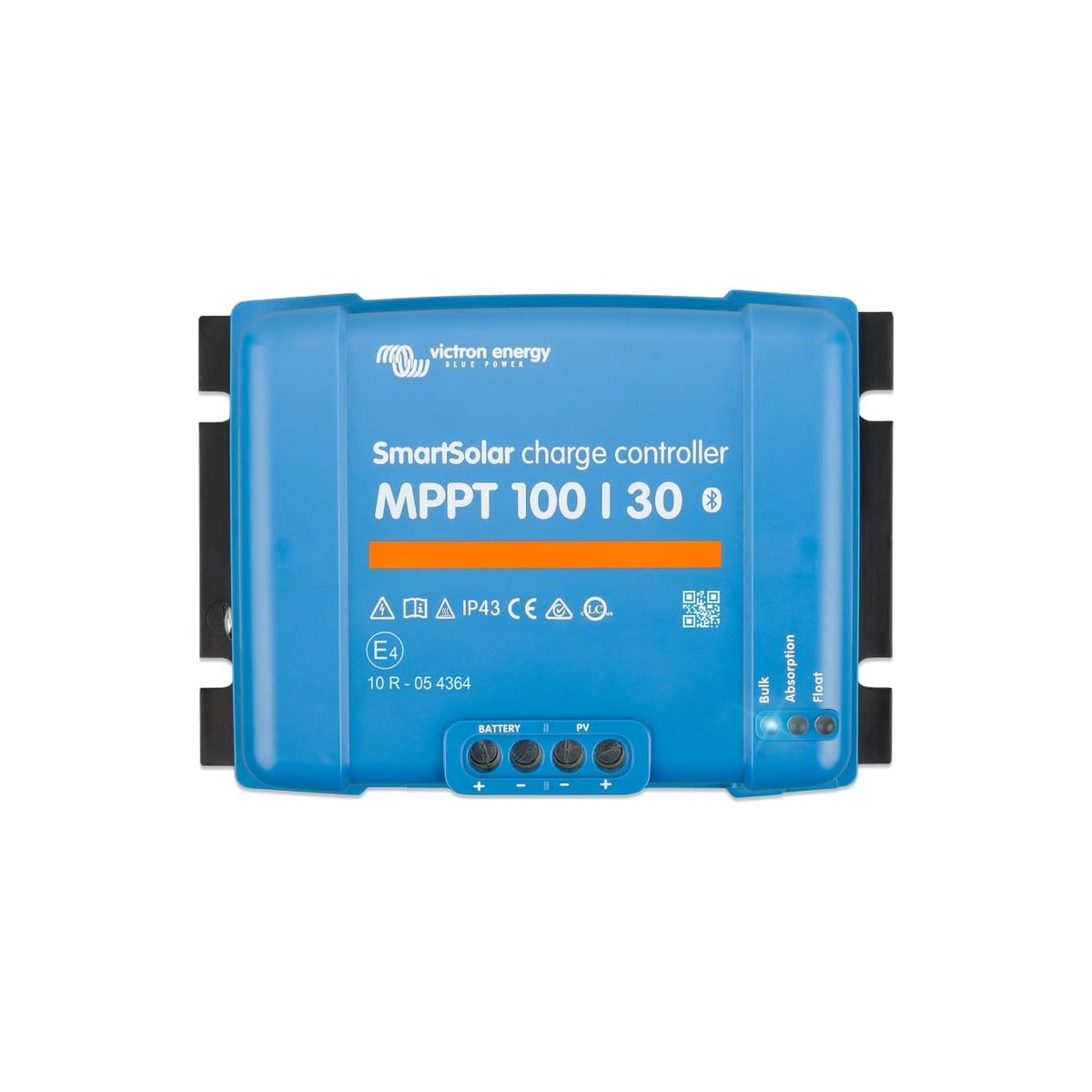
Victron SmartSolar MPPT 100/30 (100V PV input, 30A charge current, integrated Bluetooth via VictronConnect, 5-year warranty, ASIN B073ZJ3L13)
Who it's for: the 30 to 40 ft coastal cruising sailboat or trawler owner installing a 200 to 400W array on a 12V house bank, who wants the VictronConnect app ecosystem and native integration with BMV-712 battery monitors and a Cerbo GX, accepts that IP43 electronics and IP22 terminals require dry-locker mounting, and will apply the standard wiring mitigation (twisted PV leads, FT240-31 toroid ferrites) to keep switching noise off the AIS and VHF bands. This is the canonical 12V cruiser charging stack, not a budget build.
What we found: 3,265 Amazon reviews at 4.8 stars is the strongest adoption signal of any Victron MPPT in the 30A class, and the VictronConnect ecosystem (Bluetooth app, BMV-712, Cerbo GX, VRM cloud portal) is the deepest installer-supported stack in marine off-grid charging. The 100V PV input handles 2 to 3 panels in series, and the 30A output covers 440W at 12V or 880W at 24V. The native LiFePO4 preset works over Bluetooth with no cable. The honesty point: IP43 electronics and IP22 terminals is rated Indoor Type 1 Unconditioned, not marine-grade, so dry-locker mounting is required. Footprint Hero measured it at 146W versus the EPEVER and Renogy at 142W each, so you buy the ecosystem, not raw harvest.
Bottom line: the 100/30 is the corrected Victron over the RFI-flawed 75/15 (5,392 reviews), which degrades AIS receiver sensitivity above roughly 7A bulk charge. The 100/30 is not RFI-free either, so the wiring mitigation protocol is not optional on any AIS-equipped boat. The brand-of-record alternative is the Morningstar TriStar MPPT 30 at roughly $350 to $400 via direct channels, the only FCC Class B certified marine MPPT in its class. For the 30 to 40 ft cruiser doing 200 to 400W on 12V, the 100/30 at $237.99 is the answer.
- + 3,265 Amazon reviews at 4.8 stars is the strongest adoption signal of any Victron MPPT in the 30A class on the platform, and the VictronConnect ecosystem (Bluetooth app + BMV-712 battery monitor + Cerbo GX + VRM cloud portal) is the deepest installer-supported ecosystem in marine off-grid charging by a meaningful margin
- + 100V PV input ceiling handles 2 to 3 panels in series with cold-temperature open-circuit voltage margin (24V Voc panels rise to roughly 27V Voc at 0°C; three in series = 81V, well below the 100V limit); 30A output handles 440W at 12V or 880W at 24V with comfortable headroom for the 200 to 400W coastal cruiser sub-segment
- + Native LiFePO4 charging preset adjustable via VictronConnect app over Bluetooth with no cables required; this is a genuine usability advantage over EPEVER's USB-to-RS485 cable plus PC software approach, and the preset works correctly on most 12V LiFePO4 banks without manual voltage entry
- + 5-year warranty with global distributor support (Defender Marine, West Marine, eMarine Systems, Solar Biz) and the largest online cruiser knowledge base of any MPPT brand, including multi-year saltwater service threads on CruisersForum, SailNet, and Trawler Forum
- × IP43 (electronics) and IP22 (terminals) is Indoor Type 1 Unconditioned per the Victron official datasheet, NOT marine-grade by any reasonable definition; mounting must be inside a dry locker or ventilated enclosure with monthly terminal inspection and dielectric grease in humid climates (Florida Keys, SE Asia liveaboards have documented terminal corrosion at the 2 to 3 year mark when skipped)
- × All SmartSolar MPPTs (including the 100/30 itself) generate conducted and radiated noise on HF and VHF bands during bulk charge; multiple Victron community threads document AIS range degradation on the 100/30 as well as the 75/15, so the RFI mitigation protocol (twist PV leads at 15 turns per meter minimum, FT240-31 toroid ferrite chokes on both PV and battery leads close to the controller, NOT powering radio gear from the load output port, NOT routing PV cable alongside VHF coax) is NOT optional for any AIS-equipped boat where the controller is within cable-run distance of a VHF antenna
- × Footprint Hero's independent bench test puts the 100/30 at 146W harvested versus EPEVER 4210AN at 142W versus Renogy Rover 40A at 142W (within 4W of each other at peak); the 98 percent efficiency marketing claim is real on a component-level dyno but 94 to 97 percent is what real-world coastal installs measure, so you are buying the ecosystem and firmware quality, NOT raw harvesting superiority
Runner-up: Renogy Rover 40A MPPT Solar Charge Controller (100V PV input, 40A charge current, built-in LCD display, BT-2 Bluetooth dongle optional, ASIN B01MSYGZGI).
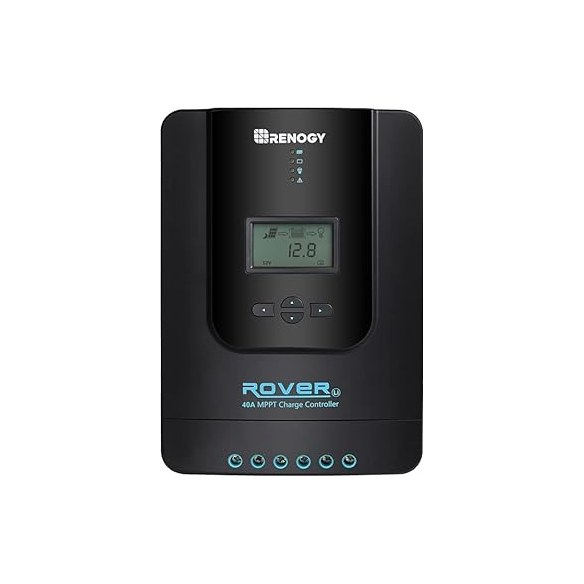
Renogy Rover 40A MPPT Solar Charge Controller (100V PV input, 40A charge current, built-in LCD display, BT-2 Bluetooth dongle optional, ASIN B01MSYGZGI)
Who it's for: the budget-conscious cruiser building a first solar system on a 200 to 520W array who wants more headroom per dollar than the Victron 100/30, prefers a built-in LCD over a phone app, is not planning to integrate a full Victron BMV plus Cerbo stack later, and accepts that the Renogy app ecosystem (DC Home) is materially thinner than VictronConnect even with the optional BT-2 Bluetooth dongle. The Rover is the right pick when you want the cleanest price-per-amp and can skip the Victron ecosystem.
What we found: 3,830 Amazon reviews at 4.4 stars is the strongest adoption signal of any MPPT in the 40A class, larger than the Victron 100/30's 3,265. The 40A output covers 520W at 12V (more than the 100/30's 440W) or 1040W at 24V, and the 100V PV input matches the Victron. The built-in LCD shows voltage, current, and harvest watt-hours without a phone; the optional BT-2 dongle ($20) adds DC Home app connectivity. Footprint Hero measured the Rover at 142W versus the Victron's 146W, within 4W at peak, so it delivers the same watts at $170.99 versus $237.99. The 4.4-star gap below the Victron's 4.8 is partly the learning curve, since the Rover exposes more parameters than the preset-driven SmartSolar.
Bottom line: no AIS interference reports specific to the Rover 40A surface in cruiser sources, making it an honest alternative for boats that cannot tolerate the Victron 75/15 RFI hassle, though all switching MPPTs need the same twisted-wire and ferrite discipline. IP32 ingress is less than the Victron's IP43, so it is still a dry-locker mount. The brand-of-record alternatives are the Victron 100/30 for ecosystem, or the Morningstar SunSaver MPPT for epoxy construction at the 200W ceiling. For 200 to 400W on 12V, the Rover 40A is the Runner-up.
- + 3,830 Amazon reviews at 4.4 stars is the strongest review-count signal of any MPPT charge controller in the 40A class on the platform, larger than the Victron 100/30's 3,265 reviews; the Rover's marine penetration in the cruiser community has grown substantially since 2021 per the operator harvest
- + 40A output handles up to 520W at 12V (more headroom than the Victron 100/30's 440W) or 1040W at 24V; the 100V PV input ceiling is identical to the 100/30 so the same 2 to 3 panel series configurations work, but the larger 40A charge current covers the upper end of the coastal cruiser array size range with comfortable margin
- + Built-in LCD display shows real-time voltage, current, daily and total harvest watt-hours, and fault codes without requiring a phone app or Bluetooth dongle; the optional BT-2 Bluetooth module ($20) adds phone connectivity via the DC Home app for buyers who want it
- + No documented AIS interference reports specific to the Rover 40A in cruiser-community sources, making it an honest alternative for boats that cannot tolerate the Victron 75/15 RFI mitigation hassle (though all MPPT switching controllers generate some conducted noise; treat the Rover with the same twisted-wire and ferrite discipline as any MPPT install)
- × 4.4-star rating is below the Victron tier (4.8 stars) and the operator harvest validates that the gap is partly due to user-configuration learning curve: the Rover exposes more adjustable parameters than the SmartSolar so first-time buyers without solar charging experience are more likely to leave a review documenting setup confusion than a Victron buyer who taps a preset in VictronConnect
- × IP32 ingress protection per the current Renogy datasheet (a minor improvement over IP30 with protection against dripping water when tilted up to 15 degrees) is still less than the Victron 100/30's IP43; mounting must be inside a dry, ventilated interior space, absolutely not cockpit-mounted, and the same monthly terminal-inspection and dielectric-grease discipline applies
- × No native integration with standalone battery monitors, VHF radios, chart plotters, or solar-electric inverter-chargers; the BT-2 Bluetooth dongle provides phone monitoring but the DC Home app lacks the depth of VictronConnect + BMV-712 + VRM cloud portal; if you plan a full Victron house-bank system later, you will replace this controller
Budget pick: Morningstar SunSaver MPPT SS-MPPT-15L (15A charge current, epoxy-encapsulated PCB, IP10 indoor enclosure, marine-rated terminals, FCC Class B certified, UL/CSA C1D2 HazLoc-rated, 5-year warranty, Designed in USA, ASIN B008H64TBU).
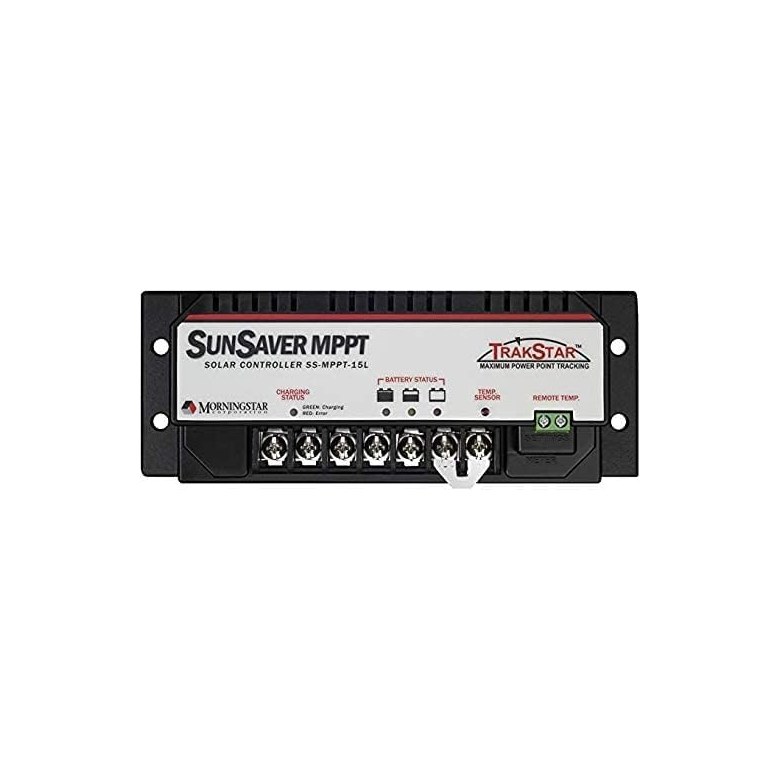
Morningstar SunSaver MPPT SS-MPPT-15L (15A charge current, epoxy-encapsulated PCB, IP10 indoor enclosure, marine-rated terminals, FCC Class B certified, UL/CSA C1D2 HazLoc-rated, 5-year warranty, Designed in USA, ASIN B008H64TBU)
Who it's for: the 25 to 35 ft coastal cruiser sizing a single 100W to 200W panel on a 12V bank who wants the only genuinely marine-grade MPPT enclosure on Amazon (epoxy-encapsulated PCB, FCC Class B certified, HazLoc-rated), accepts the 15A charge-current ceiling (200W at 12V, 400W at 24V), is willing to configure via DIP switch presets or a PC USB MeterBus adapter instead of a phone app, and values a 5-year US-made warranty over Bluetooth convenience. This is a Sub-segment A controller, not a 300W to 400W primary.
What we found: Morningstar epoxy-encapsulates the PCB and uses marine-rated terminals with conformal coating, rated for 100 percent non-condensing humidity and -40C to +60C per the datasheet. The enclosure itself is IP10 Type 1 Indoor, so it still needs a dry-locker mount; the genuine advantage is that the epoxy PCB survives a salt-air condensation event that would corrode the Victron, Renogy, or EPEVER boards. The FCC Class B emissions certification is the spec the Victron and Renogy controllers lack, and GigaParts user reviews confirm clean HF and VHF behavior alongside ham gear, so this is the principled small-array answer for SSB and Class B AIS boats. The 15A charge current caps 12V arrays at 200W and 24V at 400W.
Bottom line: the $298 price is a real step-up over the Victron 100/30 at $237.99 and the Renogy Rover 40A at $170.99, because Morningstar sells commercial-grade construction and US manufacturing. You pay for the 5-year US warranty, the epoxy PCB plus C1D2 terminals, and the FCC Class B certification. The alternative for buyers who outgrow the 15A ceiling is the Morningstar TriStar MPPT 30 at roughly $350 to $400 via direct channels. For the 25 to 30 ft weekender with one 100W to 200W panel, the SunSaver MPPT is right.
- + Epoxy-encapsulated PCB with marine-rated terminals and conformal coating rated to 100 percent non-condensing humidity and -40°C to +60°C temperature range; this is the only Amazon-buyable MPPT in this guide whose internal electronics will survive a salt-air condensation event that would corrode the Victron, Renogy, or EPEVER boards (the enclosure rating is IP10 Type 1 Indoor; like every other unit in the lineup it requires dry-locker mounting; the genuine advantage is the corrosion resistance of the PCB and terminal materials over years of salt-air exposure, NOT weather-exposure suitability)
- + FCC Class B radiated and conducted emissions certified, the only Amazon-buyable MPPT in this guide besides the Genasun GV-10 with documented RFI compliance; on a boat running AIS, VHF, and SSB, the Morningstar is structurally the lowest-noise option because the emissions limits were measured against an FCC test methodology rather than left as an open question
- + Made in the USA with a 5-year warranty and established US support structure through Morningstar Corporation (solar-electric.com, signature solar, hurricanewindpower); this is a commercial product designed for off-grid telecom and industrial installations where multi-decade service life is the design target, not a consumer-marketed solar accessory
- + HazLoc-rated for installation in hazardous-location environments (per the Amazon product title 'HazLoc Rated, Low Noise, 5 Yr. WTY - Designed in the USA'); for cruisers with installations near propane lockers, battery banks producing hydrogen during equalization, or fuel systems, the HazLoc rating is the spec that other Amazon-buyable MPPTs do not have
- × 15A charge current ceiling caps 12V array at 200W and 24V array at 400W; this is a small-array controller for Sub-segment A (weekend cruiser, single 100 to 200W panel), NOT a 300 to 400W primary controller; for larger arrays you would need two units in parallel or step to the Morningstar TriStar MPPT (direct channel only)
- × Configuration via front-panel DIP switches (4 lead-acid presets) or PC USB MeterBus adapter for custom parameters; no phone app, no Bluetooth, no built-in LCD; for cruisers accustomed to VictronConnect or the Renogy DC Home app, this is a step backward in daily usability and a step forward in installation simplicity
- × Custom LiFePO4 parameters require PC connection via the MeterBus adapter; DIP switch presets cover lead-acid (flooded, AGM, gel) only, so this is NOT plug-and-play for LFP users despite the controller itself being LiFePO4-capable; budget approximately 30 to 60 minutes of one-time PC setup if you are running LiFePO4
- × 44 Amazon reviews is moderate adoption signal compared to the Victron 100/30's 3,265 or the Renogy Rover 40A's 3,830; the rating is 4.2 stars; Morningstar is sold primarily through the marine and off-grid distributor channel (solar-electric.com, Defender, West Marine) rather than via Amazon, so the Amazon-side adoption signal is structurally smaller than the brand's actual installed base
Also worth considering.
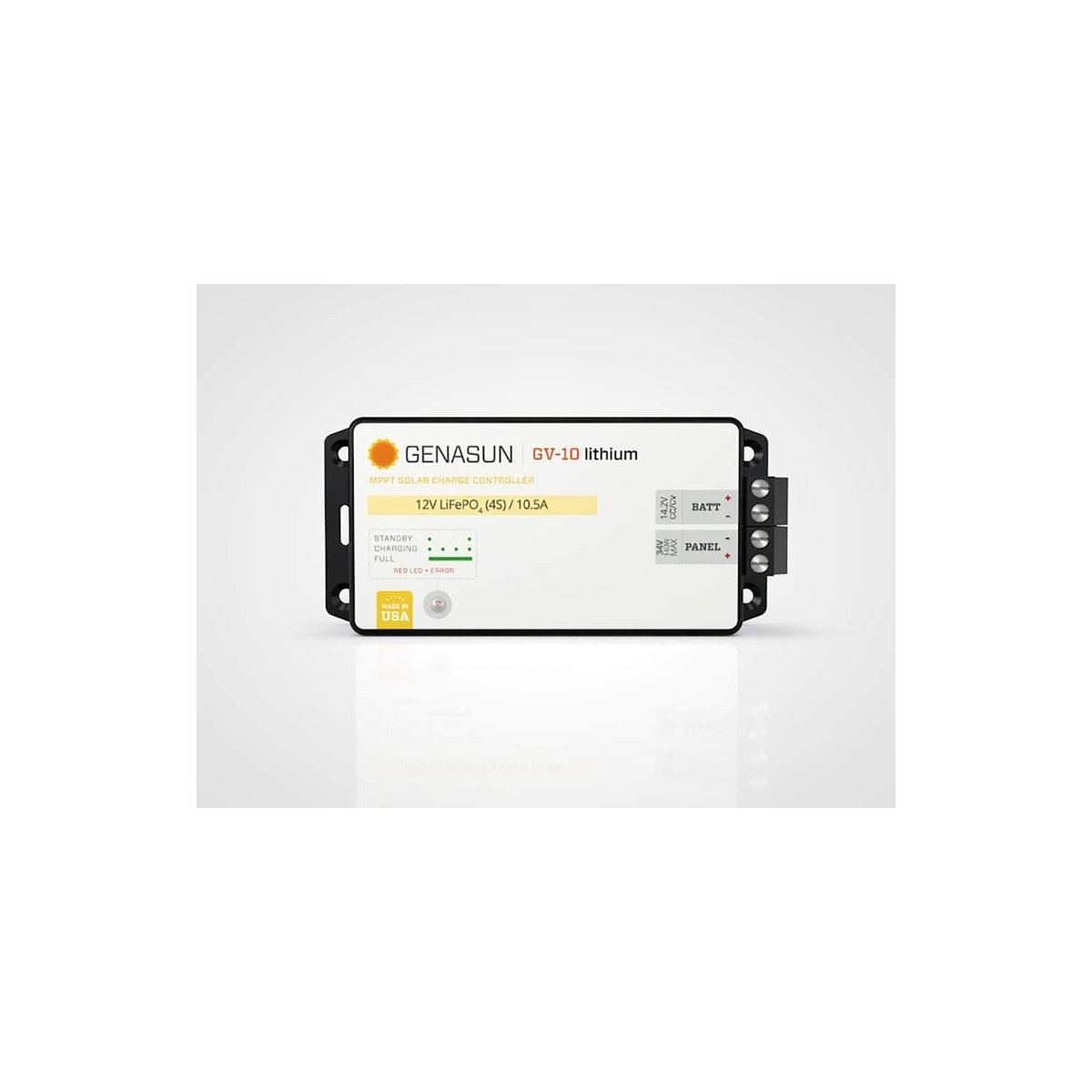
Genasun GV-10-Li-14.2V (10.5A charge current, 140W max array at 12V, fixed 14.2V LiFePO4 charge voltage, 98.3 percent peak efficiency, no fans or relays, Made in USA, 5-year warranty, ASIN B074P39MQM)
Who it's for: the radio-priority cruiser running SSB plus Class B AIS where RFI from a switching MPPT is a documented operational concern, installing a single 100W to 140W panel onto a 12.8V LiFePO4 bank. The 10.5A and 140W hard cap at 12V means this is not a scale-up option for 200W or larger arrays, and the charge voltage is fixed at the factory. It is a single-panel controller for a weekend cruiser, a dinghy or tender on LiFePO4, or a second controller dedicated to the starter battery.
What we found: Genasun is the only MPPT in this guide independently confirmed RFI-quiet by amateur radio operators running it alongside HF and VHF receivers, validated by GigaParts user reviews and the independent ham-radio test. The Maine Sail / Compass Marine benchmark used the GV-10 as the MPPT reference and rated it best value in a high-performance MPPT controller, with no discernible harvest difference from the Midnite KID or the Rogue MPT-3048. It is Made in the USA, 5-year warranty, no fans or relays (the passive design removes two common marine failure modes), 98.3 percent peak efficiency. The fixed charge voltage is the second structural limit: it ships programmed for a specific LiFePO4 voltage (14.2V most common, also 14.0V and 14.4V), and changing it means sending the unit to Sunforge LLC, so verify your bank's target voltage before ordering.
Bottom line: the spec matters for boats with SSB radios or Class B AIS where switching MPPT controllers degrade reception during bulk charge, which the Victron 75/15 does especially. For the cruiser whose priority is keeping radio gear functional during peak charging hours, the GV-10 Li at $140 is the right pick. Buyers running a 200 to 400W array on a 12V LiFePO4 bank who want RFI-clean charging should step to the Morningstar TriStar MPPT 30 with custom LiFePO4 programming at roughly $350 to $400 via solar-electric.com instead.
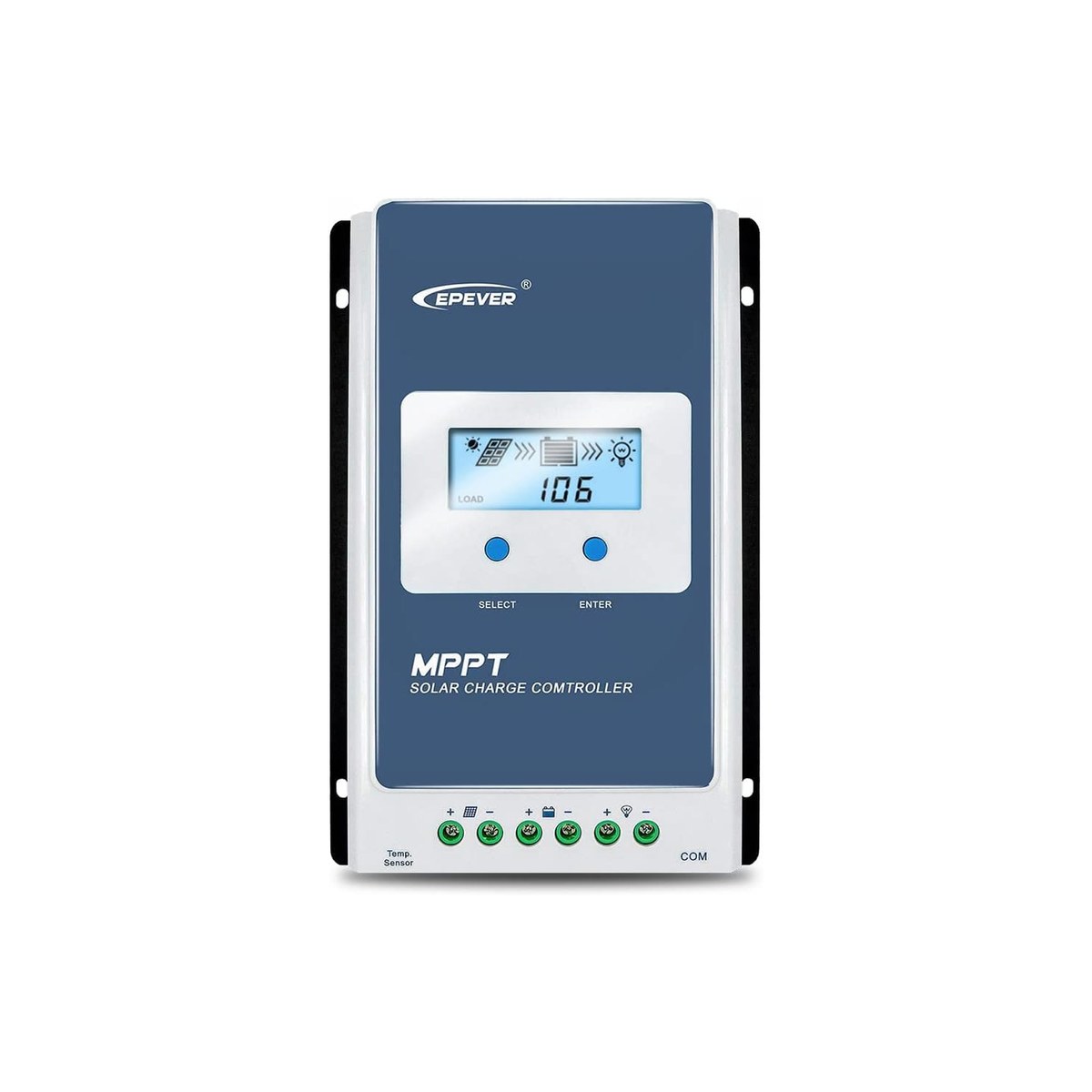
EPEVER Tracer 4210AN 40A MPPT Solar Charge Controller (100V PV input, 40A charge current, 520W max array at 12V, RS485 MT50-compatible port, LiFePO4-capable via USER mode, ASIN B081GSBGFL)
Who it's for: the budget-constrained cruiser building a first solar system on lead-acid (flooded, AGM, gel) banks, OR the LiFePO4 buyer with technical patience for 2 to 4 hours of front-panel USER mode plus optional USB-to-RS485 PC software configuration, who values absolute lowest-cost MPPT harvest within 4W of Victron and does not need Bluetooth phone monitoring or the VictronConnect ecosystem. For lead-acid banks the front-panel preset selection works with no setup tax, so the 4210AN is a straightforward purchase.
What we found: Footprint Hero's bench test measured the 4210AN at 142W versus the Victron 100/30 at 146W and the Renogy Rover 40A at 142W, all within 4W at peak, at $119.99 versus the Victron's $237.99, roughly 50 percent less for essentially the same watts. The 40A output handles 520W at 12V, the 100V PV input matches Victron and Renogy, and it is LiFePO4-capable via USER mode. The honesty hook is the LiFePO4 setup tax, which is roughly 2 to 4 hours for a prepared buyer, not 12: USER mode voltage entry from the front panel takes 20 to 45 minutes with the battery spec sheet in hand, and PC-side access needs a USB-to-RS485 cable ($15 to $25) plus EPEVER Solar Station Monitor software. The 12-hour figure is the worst case for an unprepared buyer. It ships without Bluetooth, app, or LCD; the optional MT50 wired display ($30) shows data but does not edit lithium parameters.
Bottom line: the brand-of-record alternative is the Renogy Rover Li 40A (the LiFePO4 variant of our Runner-up) at roughly $200 for buyers who want comparable harvest with substantially easier LiFePO4 programming. If you buy the EPEVER to save $40 versus Renogy Rover Li and then spend 12 hours configuring it, the time-versus-money math does not pencil. The EPEVER 4210AN is the right pick for the lead-acid budget build where the setup tax is zero, or for the technically patient LiFePO4 builder who wants the lowest-cost MPPT in the lineup and is comfortable with the RS485 cable workflow.
Skip this guide if...
Three audiences should skip this guide. First, buyers shopping for solar charge controllers for a home off-grid cabin, residential PV install, or land-based RV park hookup: the marine considerations (saltwater corrosion on terminal blocks, dry-locker mounting requirement, RFI compatibility with AIS and VHF and SSB radio gear) do not apply, and home and RV reviewers (Will Prowse, DIY Solar Power with Will Prowse) cover those use cases better than a marine-cruiser-targeted guide. Second, buyers building a wind-plus-solar hybrid charging system: hybrid controllers (Coastal Climate Control, Marlec, Eclectic Energy) are a separate product category from standalone MPPT controllers, and our lineup does not include hybrid topologies. Third, buyers who already have a PWM controller that is working fine on a small (less than 100W) panel: the MPPT-over-PWM measured gain is only meaningful above the 100W threshold where the panel-voltage-to-battery-voltage differential is large enough for the MPPT topology to harvest the difference; below 100W the upgrade does not pencil.
Don't bother with.
- × Skip Victron SmartSolar MPPT 75/15 as primary controller on any AIS-equipped boatThe Victron 75/15 is the platform's volume-king Victron MPPT at 5,392 Amazon reviews and would be the obvious review-count Top Pick, but it carries a documented current-dependent RFI issue that elevates the VHF and HF noise floor and measurably degrades AIS receiver sensitivity whenever bulk-charge current exceeds approximately 7A (range loss is documented qualitatively across multiple operator threads; the exact figure is install-dependent and not reducible to a single number). The threshold is easily exceeded by a single 100W panel in good sun. Multiple independent operators have documented the issue across the Victron Community Archive, CruisersForum's Victron MPPT EMC Issues thread, the Victron user-group Facebook (operators turning MPPTs off before SSB schedules), and the related ham-radio community sources. Victron has not acknowledged this as a product defect or issued a marine-specific firmware fix in the four-plus years the issue has been reported. AIS is collision-avoidance safety gear at anchor and in shipping lanes; this is a safety issue, not an annoyance. The correct Victron for an AIS-equipped boat is the 100/30 (our Top Pick) with the standard wiring-mitigation protocol applied (twisted PV leads, FT240-31 toroid ferrites on PV and battery leads, no radio gear on the load output port, no PV cable alongside VHF coax). The 100/30 is NOT independently confirmed RFI-clean; community threads document AIS interference on the 100/30 as well, but the cruiser-community ecosystem evidence supports it as the corrected Victron over the 75/15 once mitigation is applied.
- × Skip Generic Chinese brands (PowMr, SRNE, Simtek, Eco Worthy, Yohako, Ashapower, Felicity, SMS) at $30 to $80The Amazon SERP for MPPT charge controllers is flooded with generic Chinese brands at $30 to $80 with thin review signals and undocumented MPPT topology. Documented failure patterns: actual PWM internals despite MPPT labeling, output current capped well below the rated nameplate (PowMr Reddit thread documents a 100A nameplate controller maxing at 375W on a 900W array, equivalent to roughly 31A actual ceiling), 'night mode' activation in direct sun (the controller drops to standby state due to firmware bugs), and non-responsive Chinese-based warranty support when the unit fails. None of these brands have a verifiable multi-year saltwater track record in the cruiser-community signal. The editorial-honesty rule: if the brand does not appear in CruisersForum / SailNet / Trawler Forum discussions (Victron, Renogy, EPEVER, Morningstar, Genasun, Outback, Schneider, Midnite, Rogue, Blue Sky), do not buy on Amazon for marine deployment.
- × Skip Renogy Wanderer (PWM, not MPPT) on any modern 100W+ panel installThe Renogy Wanderer is a PWM controller, not MPPT. PWM is the wrong charge-control topology for modern 100W-plus panels with 18 to 22V Vmp because PWM gives roughly 65 percent harvest efficiency in bulk charge versus MPPT's roughly 95 percent on the same panel. The Maine Sail measured MPPT-over-PWM gain on LiFePO4 is 20.8 percent over 7 days, and the gain occurs specifically during bulk charging when the panel-to-battery voltage differential is largest. The 'up to 30 percent' marketing claim is the best case at maximum voltage differential; the real-world range is 10 to 21 percent. If you already have a Wanderer installed and the panel is more than 100W with Vmp above 18V, replace it with any MPPT pick in this lineup, the Wanderer is wasting a measurable fraction of your panel's harvest as heat at the controller.
- × Skip SRNE SR-ML2420 and similar 'marine-labeled' Chinese MPPT controllersThe 'marine' label on these products refers to enclosure-sticker color and SKU naming, NOT to an IP rating, an FCC emissions certification, or corrosion-resistant terminal-block construction. SRNE controllers have documented failure modes in corrosive marine environments per CruisersForum and DIY Solar Forum threads. The marine-labeled SKU is the same controller as the non-marine-labeled SKU with a different sticker on the enclosure. The Morningstar SunSaver MPPT in our Pick #3 slot is the only Amazon-buyable MPPT in this guide with genuine marine-grade construction (epoxy-encapsulated, FCC Class B, HazLoc-rated); the SRNE and similar 'marine' SKUs do not match that environmental spec at any price point.
- × Skip Buying a 150V PV input controller for a single 200W panel installThis is a configuration mismatch, not a brand failure. Buying an Outback FlexMax 80, Victron SmartSolar 150/45, or any 150V-class controller for a single 200W panel on a small sailboat is wasted spend and configuration over-specification. The 150V input rating is for high-voltage series-string arrays (4-plus panels in series) typical of offshore liveaboards running 600W to 2kW arrays at 24V or 48V; the single 200W panel produces roughly 22V Voc, leaving 128V of unused input headroom and forcing the controller into a low-utilization operating point that is less efficient than a properly sized 75V or 100V class controller. Size the controller's PV input ceiling to the panel array's cold-temperature Voc with comfortable margin (typically 1.3 to 1.5 times the warm-day Voc); do not buy beyond what the boat can realistically carry.
- × Skip Buying a charge controller before sizing the array, battery bank, and install locationThe right MPPT charge controller for your boat is a function of four inputs, in order: (1) the panel array's peak wattage at the battery bank voltage (a 400W array on a 12V bank needs roughly 33A charge current; with 25 percent margin, a 40A controller; the Victron 100/30 at 30A current-limits at the top of its 440W range), (2) the panel array's open-circuit voltage at cold temperature (Vmp rises roughly 10 to 15 percent in winter, and series-string arrays sum the Vmp; the controller's PV input ceiling must exceed cold Voc with margin), (3) the battery chemistry (LiFePO4, AGM, gel, flooded, each with different absorption voltages and absorption-duration profiles, and not every controller has plug-and-play LFP support), and (4) the install location (dry locker mount only for Victron, Renogy, EPEVER, Genasun; epoxy-encapsulated for Morningstar in semi-exposed locations near propane lockers or fuel systems). Buying the controller first and sizing the array second produces installs that either under-deliver charge current at peak sun or fail the wrong way at the configuration-mismatch margin.
How we picked.
Sources we read and the methodology we used
We did not pull samples and run our own torture tests. The closest thing to authoritative independent test data is Footprint Hero's bench test of the Victron SmartSolar 100/30 versus the EPEVER Tracer 4210AN versus the Renogy Rover 40A (146W versus 142W versus 142W harvested from an identical panel array, within 4W of each other at peak), Maine Sail's 7-day MPPT-versus-PWM measured gain on LiFePO4 (20.8 percent, total of 220.44 Ah for MPPT versus 182.48 Ah for PWM, not the marketing 'up to 30 percent'), the Victron Community Archive and CruisersForum's Victron MPPT EMC Issues thread documenting the 75/15 AIS interference at bulk currents above 7A, the Victron official datasheet confirming IP43 electronics and IP22 terminals rated 'Indoor Type 1 Unconditioned' (NOT marine-grade), the Morningstar SunSaver MPPT and TriStar MPPT datasheets documenting the epoxy encapsulation and FCC Class B certification, the GigaParts user reviews and independent ham-radio testing documenting the Genasun GV-10 Li as the only field-confirmed RFI-quiet MPPT, the DIY Solar Forum and Hagensieker.com threads documenting the EPEVER LiFePO4 setup tax via USB-to-RS485 cable and EPEVER Solar Station Monitor software, and the cross-cluster carry-forward from our Marine Solar Panels guide on the Stäubli MC4 install rule. What we did is read those sources directly, then verify the surprising claims against manufacturer-of-record spec sheets, current 2026 Amazon retailer pricing pages, and the cruiser-community discussion archives. We discarded sources that could not be attributed to a named test methodology, a manufacturer datasheet, or a dated forum thread.
Why Victron leads by ecosystem convention, not hardware superiority
The first editorial honesty point: the cruising community adopted Victron by ecosystem convention (VictronConnect app + BMV-712 battery monitor + Cerbo GX + VRM cloud portal), NOT because Victron MPPT controllers are the best-sealed, lowest-RFI, or most efficient units on the market. The hardware evidence says the 100/30 is still the right Top Pick for most 25 to 45 ft coastal cruisers running 200 to 400W arrays, but only after acknowledging three non-negotiable facts: the Victron IP rating is Indoor Type 1, the Victron 75/15 has a documented AIS interference issue, and the bench-tested harvest delta versus EPEVER and Renogy is 4W at peak (146W versus 142W versus 142W in Footprint Hero's controlled bench test, parity not superiority). Victron's real advantages are the VictronConnect Bluetooth app (significantly better than the Renogy DC Home app or any EPEVER monitoring solution), native integration with BMV-712 battery monitors and the Cerbo GX system controller, a 5-year warranty with global distributor support, and the largest online cruiser knowledge base of any MPPT brand. These are ecosystem advantages, NOT hardware superiority.
The Morningstar SunSaver MPPT: the only Amazon-buyable epoxy-encapsulated marine-spec PCB
The second editorial honesty point: the Morningstar SunSaver MPPT is the only epoxy-encapsulated, FCC Class B certified, genuinely marine-hardened MPPT in this guide and belongs on every boat where the 15A and 200W ceiling fits the array. Morningstar's epoxy encapsulation of the PCB and the UL/CSA Class I Division 2 hazardous-location terminal rating are the structural construction advantages that separate this controller from the Victron, Renogy, and EPEVER alternatives. The IP10 enclosure still requires dry-locker mounting (epoxy-encapsulated PCB does not mean the unit is splash-proof), but on the spec-sheet-level test (FCC Class B emissions certified, epoxy-PCB construction, marine-grade terminal block), the SunSaver is the only Amazon-buyable MPPT that earns the marine-spec designation outright. The 15A and 200W on 12V (or 400W on 24V) class ceiling limits it to single-panel installs, but for the 25 to 30 ft weekend cruiser with a single 100 to 200W panel, this is the right marine-spec answer.
The Genasun GV-10 Li: the only field-confirmed RFI-quiet MPPT for SSB and AIS installs
The third editorial honesty point: the Genasun GV-10 Li is the only independently confirmed RFI-quiet MPPT in field testing, which makes it the correct call for boats with active SSB or Class B AIS that cannot tolerate the wiring mitigation required by every switching-mode MPPT (which includes Victron, Renogy, and EPEVER alike). GigaParts user reviews plus independent ham-radio testing confirm the Genasun's RFI signature is below the noise floor of standard marine radio installs, where Victron and Renogy and EPEVER all generate conducted and radiated noise during bulk charging that degrades VHF, AIS, and SSB reception without the FT240-31 toroid choke plus 15 turns-per-meter twisted PV lead mitigation protocol. For the radio-priority install (SSB plus Class B AIS) with a single 100 to 140W LiFePO4 panel, the Genasun is the only MPPT in the lineup that works without the mitigation tax.
The shortlist: five Amazon-buyable picks plus two we rejected
The shortlist started with the 5 Amazon-buyable MPPT charge controllers that surfaced with the strongest editorial claims and clearest sub-segment fit during Chrome MCP verification on 2026-05-28: the Victron SmartSolar MPPT 100/30 (B073ZJ3L13, 3,265 reviews at 4.8 stars, $237.99, the corrected Victron Top Pick over the RFI-flawed 75/15); the Renogy Rover 40A MPPT (B01MSYGZGI, 3,830 reviews at 4.4 stars, $170.99, the Runner-up with 520W headroom and built-in LCD); the Morningstar SunSaver MPPT SS-MPPT-15L (B008H64TBU, 44 reviews at 4.2 stars, $298, the only Amazon-buyable MPPT with genuinely marine-spec internal construction via epoxy-encapsulated PCB plus UL/CSA C1D2 hazardous-location terminals, IP10 enclosure still requires dry-locker mounting, sized for single-panel 100 to 200W on 12V or 400W on 24V only); the Genasun GV-10-Li-14.2V (B074P39MQM, 47 reviews at 4.7 stars, $140, the only independently confirmed RFI-quiet MPPT); and the EPEVER Tracer 4210AN 40A (B081GSBGFL, 130 reviews at 4.6 stars, $119.99-$140 with sale fluctuation, the Best Value LiFePO4 pick with the documented 2-4 hour setup tax acknowledged honestly). Two controllers we verified and rejected: the Victron SmartSolar MPPT 75/15 (B075NQQRPD, 5,392 reviews, $115, the platform's volume-king Victron) because the documented current-dependent RFI degrading AIS reception above 7A bulk charge makes it a HARD NO as a Top Pick on any AIS-equipped boat, regardless of Amazon adoption signal; and the Victron SmartSolar MPPT 150/45 (B09KF94CJH, 358 reviews, $189, the 24V offshore step-up) because the 150V input class is offshore-specialty and over-specification for the 12V coastal cruiser sub-segment that the rest of this lineup targets.
Six brand-of-record alternatives we considered: TriStar, Outback, Schneider, Blue Sky, Midnite, Renogy Rover Li
We considered six brand-of-record alternatives via the editorial-honesty notes that are NOT on Amazon as primary picks: Morningstar TriStar MPPT 30 and 60 (the FCC Class B certified flagship for 35 to 45 ft bluewater installs at $350 to $400 via solar-electric.com); Outback FlexMax 60 and 80 (correct for 600W to 2kW offshore arrays at 48V at $600-plus via direct channels); Schneider Electric Conext MPPT (commercial-grade residential PV); Blue Sky SB1524ix (Pacific NW cruiser favorite, older but still in service); Midnite Solar KID (off-grid cabin and small-yacht favorite); and the Renogy Rover Li 40A (the LFP variant of our Runner-up at roughly $200 with easier LiFePO4 programming than the standard Rover 40A).
How the lineup is defended: five sub-segments by array size and use case
The lineup spans five sub-segments by array size and use case: Sub-segment A (25 to 30 ft weekend cruiser, single 100 to 200W panel) maps to the Morningstar SunSaver MPPT (Pick #3) for genuine marine-spec construction OR the Victron 100/30 (Top Pick) for ecosystem continuity; Sub-segment B (30 to 40 ft coastal cruiser, 200 to 400W array on 12V) is the canonical Victron 100/30 sub-segment and the Top Pick; Sub-segment C (40-plus ft liveaboard, 400 to 520W on 12V or 24V) maps to the Renogy Rover 40A (Runner-up) for headroom-per-dollar OR to the Victron 100/50 via the editorial-honesty section for ecosystem buyers; Sub-segment D (budget LiFePO4 build) maps to the EPEVER Tracer 4210AN (Pick #5) with the 2-4 hour setup tax acknowledged honestly; Sub-segment E (radio-priority install with SSB + Class B AIS) maps to the Genasun GV-10 Li (Pick #4) as the only field-confirmed RFI-quiet MPPT.
Three non-negotiable install rules: Stäubli MC4 + RFI mitigation + dry-locker mount
The three non-negotiable install rules apply to every pick in this lineup. First, the Stäubli MC4 connector upgrade carries forward from our Marine Solar Panels guide: replace factory MC4 connectors on the panel-side wiring with genuine Stäubli MC4s before marine deployment, because generic MC4s fail to galvanic corrosion within 6 to 12 months on saltwater installs and the upgrade extends panel-and-connector service life from 2 to 3 years to 15-plus years. Apply a trace of dielectric grease ONLY to the rubber seal and gasket portions of the connector to keep the seals pliable under UV exposure; do NOT pack grease into the metal pin contact area, because dielectric grease is an insulator and will increase contact resistance. Second, the RFI mitigation protocol applies to any switching MPPT (which is every pick in this guide except the Genasun): twist PV leads at 15 turns per meter minimum from panel to controller, install an FT240-31 toroid ferrite choke on both the PV leads and the battery leads close to the controller, do NOT power radio gear from the controller's load output port, and do NOT route PV cable alongside VHF coax. Third, the controller must mount inside a dry locker or ventilated enclosure (none of the Amazon picks are cockpit-mountable) with monthly inspection and dielectric grease on terminals in humid climates like the Florida Keys and SE Asia liveaboard regions where terminal corrosion at the 2 to 3 year mark is documented in cruiser-forum threads when the inspection is skipped.
FAQs.
Q01 MPPT charge controller vs PWM: how much will an MPPT controller actually improve my charging on a modern 100W-plus panel?
+
Q02 Do I need a 30 amp MPPT charge controller or a 40 amp MPPT charge controller for my 400W array?
+
Q03 Will my MPPT solar controller interfere with my AIS, VHF, or SSB radio?
+
Q04 Is Victron actually better than EPEVER or Renogy, or is it just popular in the cruiser community?
+
Q05 MPPT charge controller for lithium batteries: which controllers in this lineup support LiFePO4 plug-and-play?
+
Q06 What is an MPPT charge controller, and how does it actually work?
+
Q07 Can I run a 24V or 36V panel array on a 12V battery bank? What does '24V to 12V' mean for MPPT controller sizing?
+
Q08 What is the average price for a good marine MPPT charge controller in 2026?
+
Q09 Should I install one large MPPT controller or two smaller ones in parallel for a 4-panel array?
+
Q10 What about cheap generic MPPT controllers (PowMr, SRNE, Eco Worthy) at $30 to $80 on Amazon? Are any of them actually OK?
+
If you, then this.
- IF 30 to 40 ft cruiser, 200 to 400W on 12V, AIS-equipped, Victron ecosystem buyerGET Victron SmartSolar MPPT 100/30 (Top Pick)$237.99 →
- IF Cruiser skipping Victron ecosystem, 200 to 520W on 12V, wants built-in LCDGET Renogy Rover 40A MPPT (Runner-up)$170.99 →
- IF 25 to 30 ft weekend cruiser, single 100 to 200W panel on 12V, wants epoxy-encapsulated PCB + C1D2 terminalsGET Morningstar SunSaver MPPT SS-MPPT-15L (Marine-Spec)$298.00 →
- IF Radio-priority install (SSB + Class B AIS), single 100 to 140W LiFePO4 panelGET Genasun GV-10-Li-14.2V (RFI-Quiet specialty)$140 →
- IF Budget LiFePO4 build, technical patience for RS485 cable setup, lowest-cost MPPTGET EPEVER Tracer 4210AN 40A (Best Value)$119.99 →
Boat Gear: The Complete Guide
The whole-boat picture →Every system on a 20 to 45 ft coastal boat, organized in one place, with the one guide we trust for each.